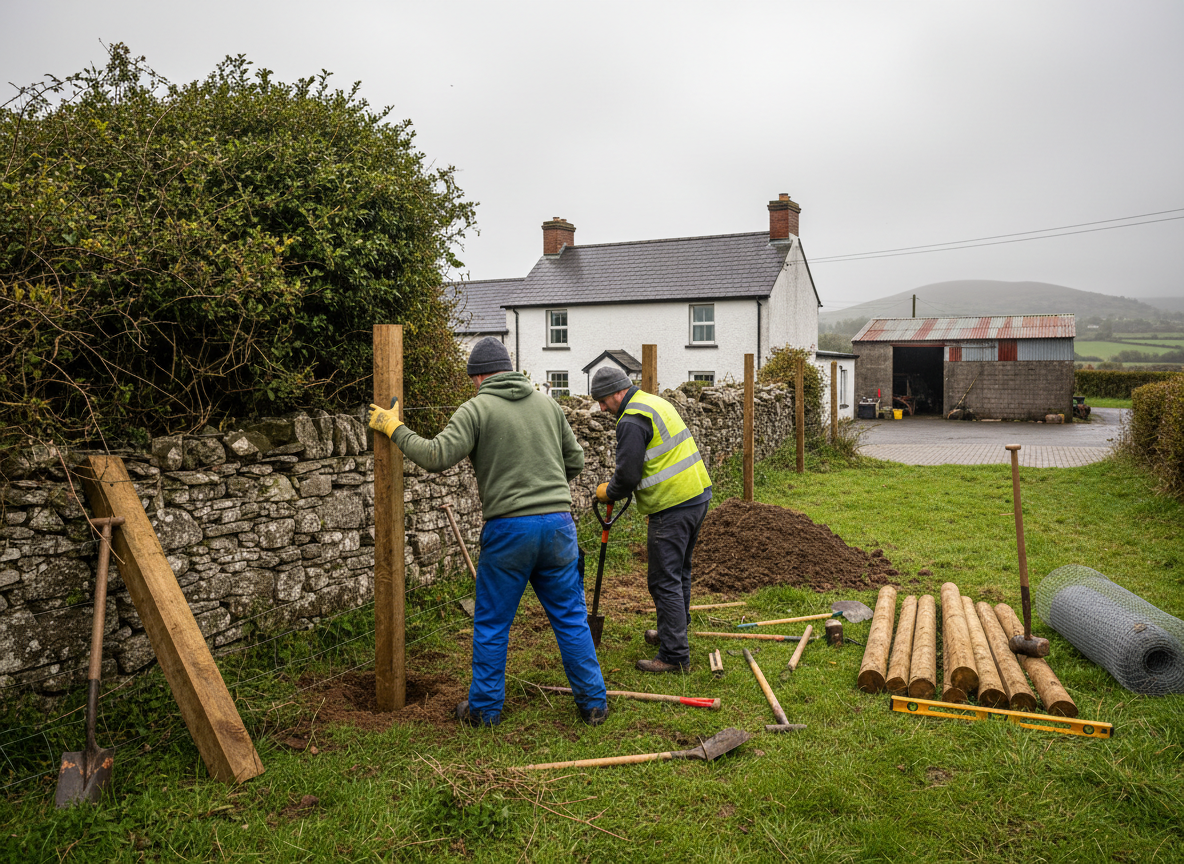
Timber fencing remains the most common boundary solution on properties throughout Connacht because it blends with stone walls, hedges and existing outbuildings while providing clear separation. Local ground conditions often include heavy clay or shallow topsoil over rock, which affects how posts are set and how long they last. Wind-driven rain and persistent damp encourage moss and algae growth on north-facing sections, so the choice of timber species and treatment level directly influences service life.
Customers typically request new fencing when replacing rotten posts and rails, extending a boundary after land purchase, or meeting insurance requirements for livestock or child safety. Agricultural holdings need stock-proof post-and-rail or strained-wire systems, while commercial sites often require solid closeboard or panel styles for security and privacy. Coastal exposure in areas such as Connemara or north Mayo accelerates weathering on any timber that is not properly pressure-treated or regularly maintained.
Work commonly begins with a site visit to measure runs, identify high-wind zones and note changes in level. Posts are set in concrete or driven depending on soil type, rails fixed, and boards or panels attached. Gates are hung on appropriate hinges and fitted with latches suited to the use. Surplus soil is removed and the area left tidy.
The same fencing can serve residential gardens, small commercial yards and working farms, provided the specification matches the load and exposure. Height, board thickness and post spacing are adjusted accordingly rather than using a single domestic standard everywhere.
Technician insight
Timber fencing in exposed or wet locations needs to be specified with ground conditions, drainage and wind exposure in mind.
Example Situation
For example, a property may have an existing fence leaning after winter storms with several posts rotted at ground level. Assessment shows shallow soil and poor drainage around the original posts. New deeper-set posts with improved drainage and heavier rails are installed along the same line to restore stability.
Timber Fencing Services We Offer
✓Closeboard Fencing
Vertical overlapping boards fixed to rails for privacy and wind resistance on garden boundaries.
✓Post and Rail Fencing
Horizontal rails on stout posts, commonly used for field boundaries and livestock separation.
✓Panel Fencing
Pre-made timber panels slotted between posts for quicker installation on level ground.
✓Timber Gate Supply and Fit
Single or double gates hung on timber or steel posts with appropriate hinges and fastenings.
✓Boundary Repair and Replacement
Removal of failed sections and installation of matching new timber to restore an existing line.
✓Strained Wire and Post Systems
Posts with tensioned wire for stock control on larger agricultural holdings.
How it works
- 1
Site Assessment
Measure the run, note ground conditions, levels and exposure to prevailing winds.
- 2
Specification and Quote
Agree timber grade, post spacing and finish details based on the intended use and location.
- 3
Installation
Set posts, fix rails and boards or panels, hang gates and tidy the working area.
- 4
Handover
Walk the completed fence with the customer and explain any ongoing care needs.
Pricing
Final cost is influenced by fence length, height, ground conditions, number of gates, and degree of coastal or hill exposure.