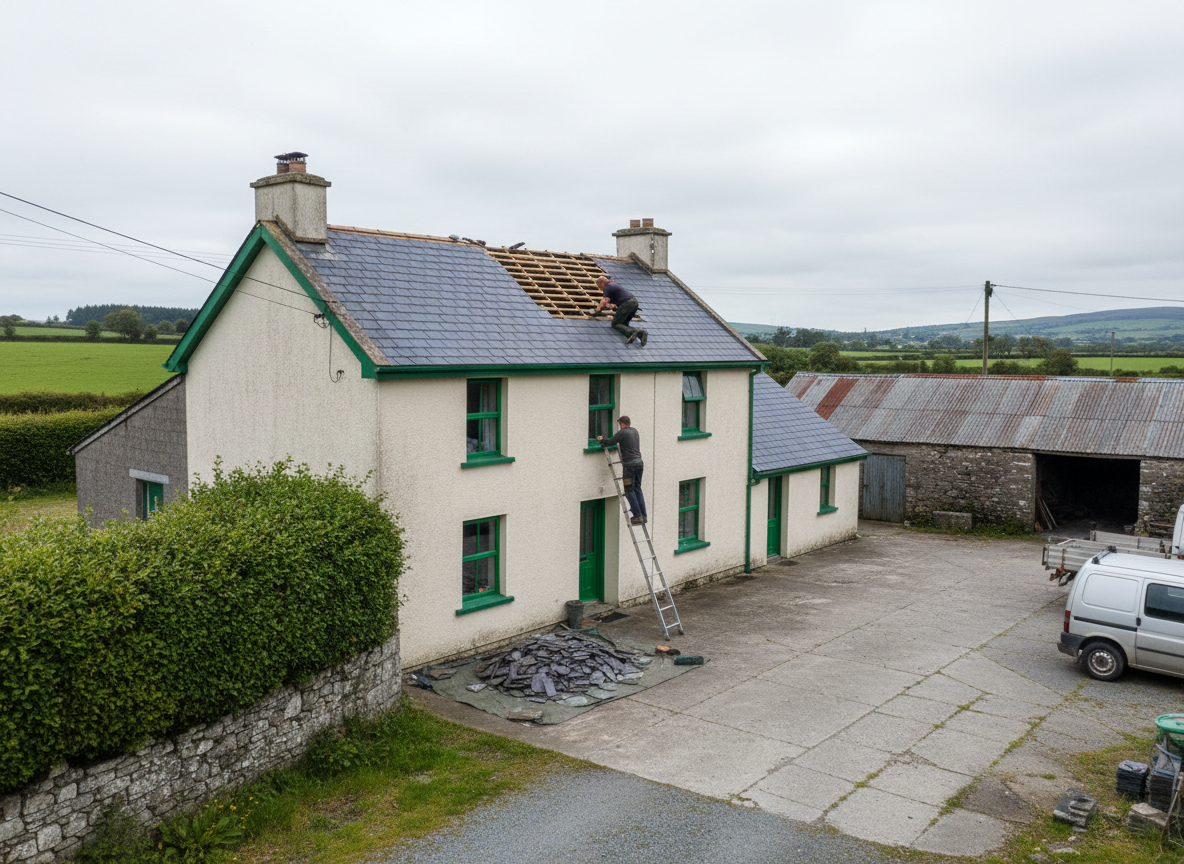
Roof repairs in the west of Ireland must contend with frequent wind-driven rain and coastal salt exposure that accelerates wear on slate and tile. Properties in exposed townlands around Galway Bay or the Mayo coast often see water forced under laps that remain watertight elsewhere. Timely intervention prevents moisture reaching timber sarking or insulation.
Work typically begins with a close inspection of the roof plane, ridges, valleys and abutments. Repairs may involve re-fixing or replacing individual slates, re-pointing ridge tiles with lime mortar, renewing lead or felt flashings, and clearing blocked valleys that trap debris during storms. Access difficulties on two-storey or outbuilding roofs influence the method chosen.
Agricultural sheds and commercial premises present additional considerations such as large-span corrugated sheeting or asbestos-cement panels that require different handling. Residential work often centres on older slate roofs where nail fatigue and moss build-up combine to dislodge units during gales.
Common Reasons for Roof Repairs
Persistent damp patches on ceilings, slipped or missing slates after winter storms, ridge tiles displaced by high winds, and valley gutters choked with moss and leaves are frequent triggers. Coastal properties also suffer accelerated corrosion of metal flashings and fixings.
What the Work May Include
Repairs can range from isolated slate replacement and ridge re-bedding to valley gutter renewal and chimney abutment flashing. All work uses standard Irish and UK trade methods and materials appropriate to the existing roof construction.
Technician insight
In Galway, the thing that catches most people out with Roof Repairs is how wind-driven rain finds its way under the laps on pre-1970s slate roofs once the nails start to corrode, especially on houses facing open fields or the coast where there is little shelter.
Example Situation
For example, a property may show recurring damp on an upstairs ceiling after successive winter storms. Inspection reveals several slipped slates and a displaced ridge tile on the exposed elevation. The repair involves re-fixing the slates, re-bedding the ridge and renewing the adjacent flashing. Once complete the ceiling remains dry through the next wet season.
Roof Repairs Services We Offer
✓Slate Repairs
Re-fixing or replacing slipped or broken natural slates and restoring the weatherproof lap on pitched roofs.
✓Ridge Tile Repairs
Re-bedding or replacing ridge and hip tiles that have been lifted or cracked by wind and age.
✓Valley Gutter Repairs
Clearing, re-lining or renewing lead and felt valleys where debris and water ponding cause leaks.
✓Chimney Flashing Repairs
Renewing stepped flashings and soakers around chimneys and abutments to stop water ingress.
✓Eaves and Verge Repairs
Restoring damaged eaves courses, barge boards and undercloak pointing where wind-driven rain enters.
✓Corrugated Roof Repairs
Sealing or replacing damaged sheets and fixings on agricultural sheds and outbuildings.
How it works
- 1
Site Assessment
Visual inspection from ground and, where safe, from the roof to identify failed slates, ridges, valleys and flashings.
- 2
Scope Definition
Discussion of findings and agreement on which areas require repair versus full replacement.
- 3
Repair Execution
Carrying out agreed works using ladders, scaffolding or roof ladders as needed while protecting the remaining roof covering.
- 4
Final Check
Walk-through with the customer to confirm the repaired sections are watertight and debris has been removed.
Pricing
Scope and cost depend on roof height, access, extent of damage and whether the work is on slate, tile or corrugated sheeting.