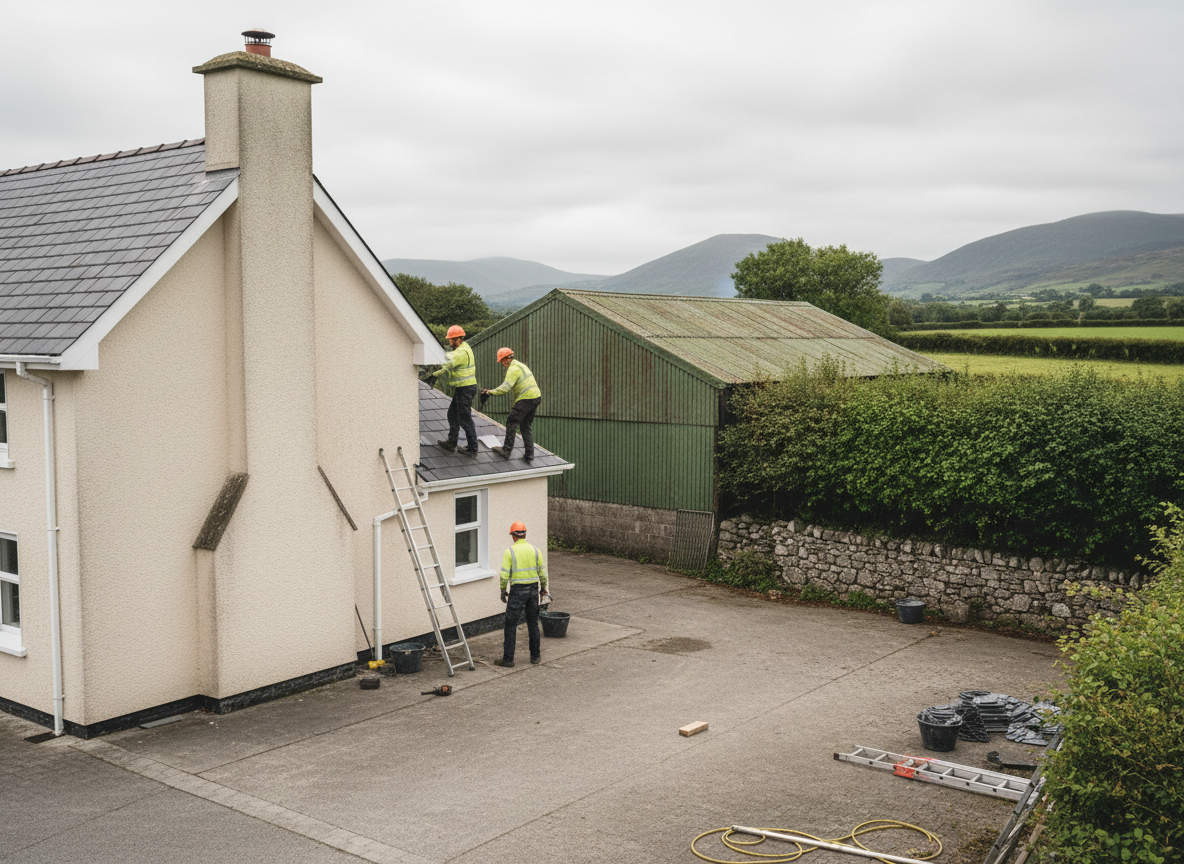
Roofs in the west of Ireland face constant wind-driven rain and salt-laden air that forces water under slates and tiles, particularly on older properties where the original felt has perished. Regular inspection of flashings, ridges and valleys prevents water reaching rafters and insulation. Work often centres on replacing failed sections rather than entire roof coverings, using traditional materials that match existing construction.
Common reasons customers contact roofing services include persistent damp patches on ceilings after storms, slipped or broken slates allowing moss to take hold, and valley gutters blocked by leaves and lichen. Agricultural buildings frequently need attention where corrugated sheets have corroded at fixings, while commercial premises may require flat roof felt repairs around rooflights. These issues develop gradually from repeated wetting and drying cycles rather than single events.
Work may include stripping and relaying slates or tiles, renewing ridge and hip tiles with fresh mortar or clips, installing new lead flashings around chimneys and abutments, clearing and relining gutters, and treating roof surfaces to control algae. Access is often gained via scaffolding or cherry pickers on two-storey buildings; single-storey farm structures allow simpler ladder and roof-ladder methods. All repairs aim to restore the original weather line without altering the roof's appearance.
Factors Affecting Scope and Cost
Roof pitch, the age and type of covering, ease of access on terraced or hillside sites, and whether matching second-hand slates are required all influence the extent of work. Coastal properties may need additional fixings to resist uplift, while inland farms often require attention to large-span sheds where purlins have moved.
Technician insight
In Galway, the thing that catches most people out with Roofing Services is the way wind-driven rain finds its way behind chimneys on 19th-century stone cottages when the original lead has lifted at the corners.
Example Situation
For example, a property may experience water ingress around a valley gutter during prolonged Atlantic storms. Inspection often reveals deteriorated underfelt allowing moisture to reach timber. Replacement of the affected section with new code 5 lead and reinforced felt restores the weatherproofing without full roof replacement.
Roofing Services Services We Offer
✓Slate Roof Repairs
Replacement of broken or slipped natural slates and reinstallation of displaced courses using traditional nailing methods.
✓Ridge and Hip Tile Replacement
Renewal of ridge and hip tiles with appropriate mortar or mechanical clips to restore the weatherproof crest.
✓Lead Flashing Renewal
Cutting out and dressing new code 4 or code 5 lead around chimneys, abutments and valleys to prevent water ingress.
✓Valley Gutter Repair
Cleaning, relining or replacing zinc or lead valley gutters where water has been ponding or overflowing.
✓Moss and Algae Treatment
Removal of organic growth followed by application of approved roof treatment to slow regrowth on north-facing slopes.
✓Flat Roof Felt Repairs
Patch repairs or partial overlay of reinforced bitumen felt on outbuildings, extensions and small commercial roofs.
How it works
- 1
Site Assessment
A visual inspection from ground level and accessible roof areas identifies slipped coverings, failed flashings and drainage problems.
- 2
Scope Definition
The extent of repair is agreed, noting which materials can be salvaged and where new sections must be introduced.
- 3
Weatherproofing Work
Repairs are carried out in manageable sections, maintaining temporary protection overnight where necessary.
- 4
Final Check
All replaced elements are tested for fit and security, with loose debris cleared from gutters and valleys before completion.
Pricing
Scope and cost depend on access, extent of damage and materials required.