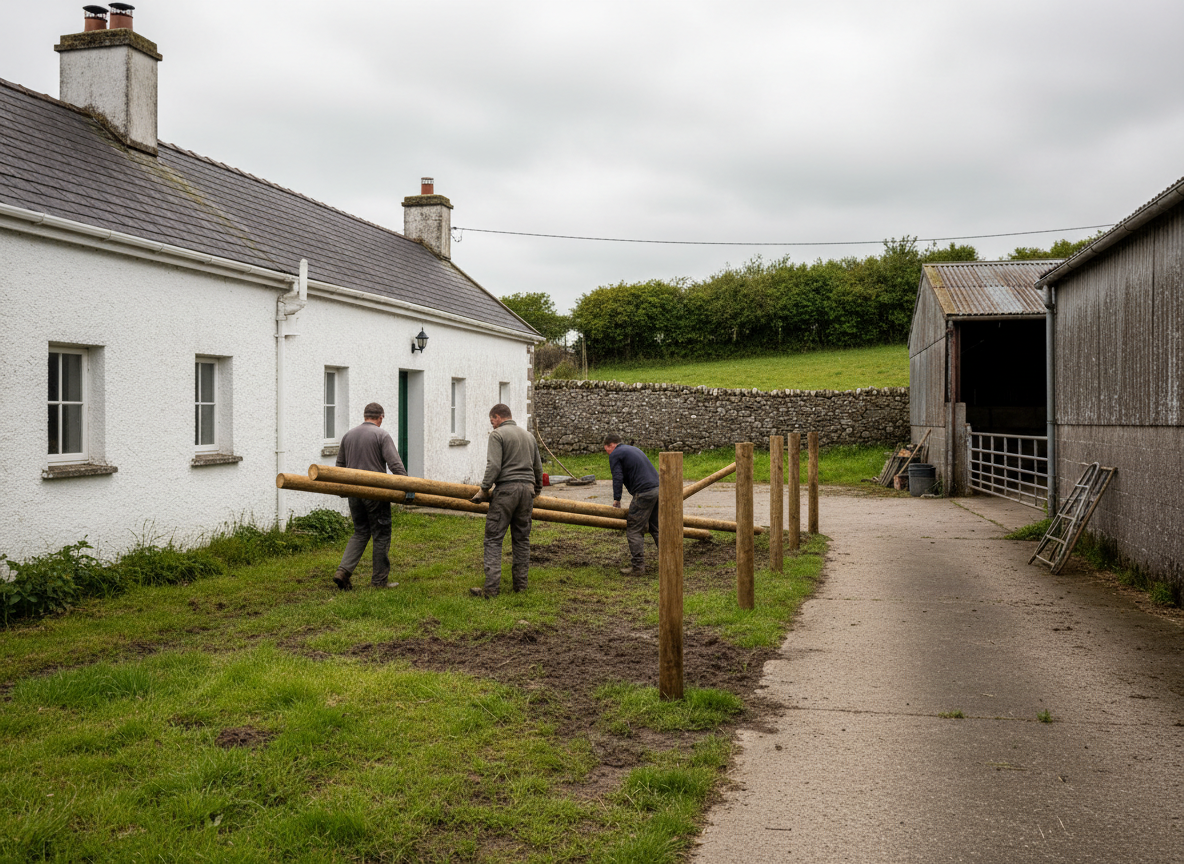
Post and rail fencing remains a practical choice across the western counties where fields meet roads and properties require clear stock-proof boundaries. The style uses vertical posts with horizontal rails, allowing airflow while providing a visible barrier that suits both livestock control and garden demarcation. Persistent damp and wind-driven rain common along the Atlantic coast accelerate timber decay and can loosen fixings if joints are not prepared correctly.
Customers typically seek this fencing when replacing older timber boundaries that have rotted at ground level, when dividing newly acquired land, or when adding a traditional boundary style suited to a rural setting. Work often involves setting new posts into varying soil types ranging from heavy clays in Roscommon to thinner stony ground in parts of Mayo and Sligo. Extra bracing or deeper settings become necessary on exposed sites subject to winter storms.
The installation sequence accounts for existing boundaries, underground services and access for machinery on smaller residential plots or larger agricultural holdings. Rails are fixed to resist lateral movement from livestock or strong gusts, and gates are integrated where regular vehicle or pedestrian passage is required. Agricultural, residential and commercial sites each present distinct loading and height considerations that affect rail spacing and post diameter.
Common Reasons for Post and Rail Fencing
Properties in Leitrim and Galway often require new runs when old stone walls or wire fences fail to contain stock or when garden privacy needs a more open rural appearance. Commercial sites may add runs to separate yards or car parks while maintaining a low-maintenance traditional finish.
Factors Affecting Scope and Cost
Ground conditions, slope, required height, gate numbers and proximity to the coast all influence labour and material quantities. Coastal exposure increases the need for additional fixings and treatment consideration, while inland fields with poor drainage may require extra post depth.
Technician insight
Post and rail fencing should be specified around the intended use, ground conditions, slope and exposure of the site.
Post & Rail Fencing Services We Offer
✓Agricultural Post and Rail Fencing
Stock-proof runs using deeper posts and closer rail spacing suited to cattle and sheep containment on farms in Mayo and Roscommon.
✓Boundary Post and Rail Installation
New boundary lines marked and erected between neighbouring properties or along roadside edges in Galway and Sligo.
✓Post and Rail Gate Integration
Single or double gates hung within post and rail runs to allow machinery, livestock or vehicle access without weakening the fence line.
✓Repair of Existing Post and Rail
Replacement of rotten posts, split rails or loose joints on older fences while retaining sound sections where possible.
✓Exposed Site Post and Rail
Strengthened construction with additional bracing for locations facing regular Atlantic storms and salt-laden winds.
✓Residential Garden Post and Rail
Lower height runs with neater finishes for garden perimeters and driveways in towns and villages across the region.
How it works
- 1
Site Visit and Measurement
Walk the proposed line to record ground levels, existing obstacles and required fence height.
- 2
Material Planning
Select post and rail dimensions appropriate to the intended use and local exposure conditions.
- 3
Post Setting and Rail Fixing
Posts are placed and rails attached progressively, maintaining line and level across the run.
- 4
Finishing and Handover
Gates are hung if required, surplus material removed and the fence checked for tension and alignment.
Pricing
Scope and cost depend on length, ground conditions, slope, gate requirements and coastal exposure.