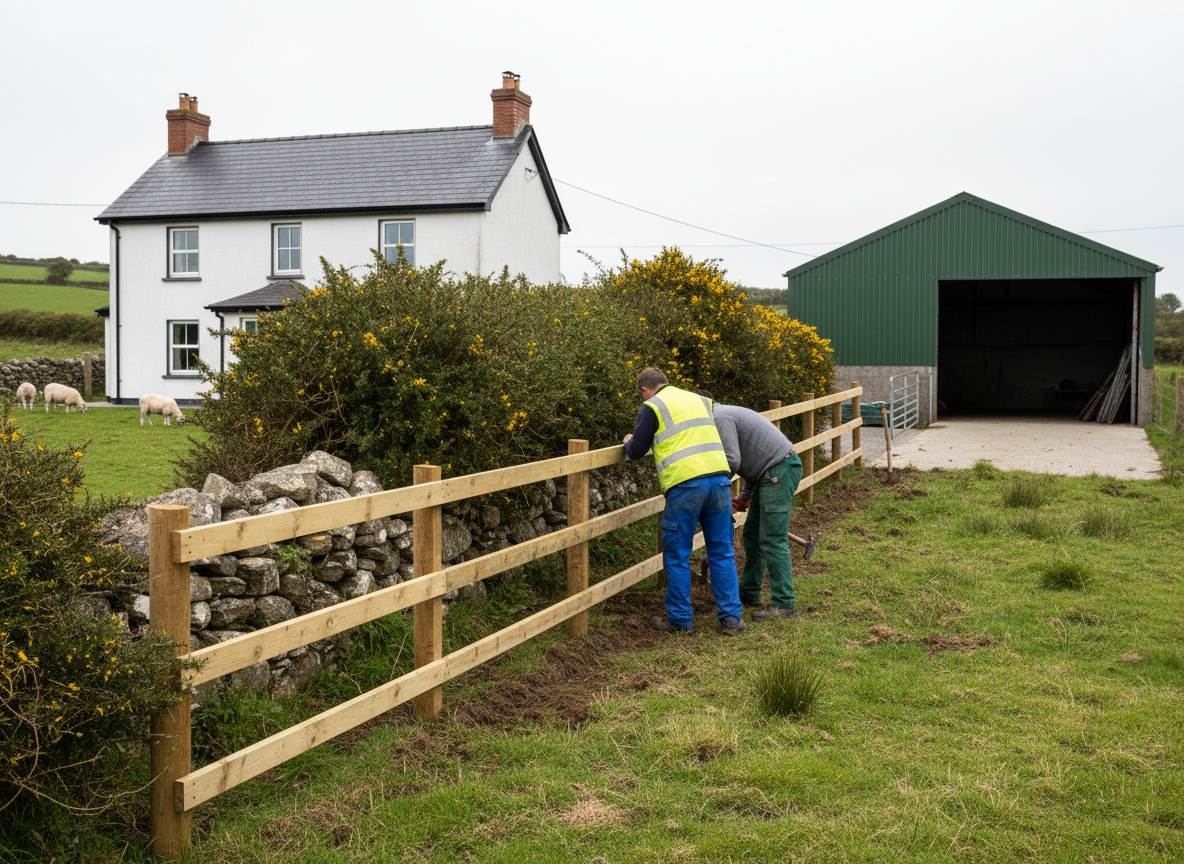
Fence work in the west of Ireland must account for constant wind-driven rain, salt air near the coast and heavy clay or rocky ground that shifts with wet winters. Posts need proper depth and drainage to avoid rot or heaving, while rails and cladding should allow water to escape rather than trap it against the timber or mesh.
Customers typically call when an existing fence has failed due to storm damage, when they need to divide land for livestock, or when planning permission or insurance requires a defined boundary. Replacement jobs often involve removing old concrete or rotted timber before new posts can be set.
The work may include digging or augering post holes, setting treated timber or concrete posts, fitting rails, mesh, boards or panels, and finishing with appropriate fixings that resist corrosion in damp conditions. On agricultural sites this can extend to straining wires and gates.
Scope and cost are affected by ground type, slope, required height, whether existing material must be cleared, and the distance from the nearest road for material delivery. Coastal sites often need heavier posts and more frequent bracing.
Technician insight
In Galway the thing that catches most people out with fence work is the mix of heavy clay and frequent rain; posts set too shallow or without decent drainage heave within two winters and the whole line has to come out again.
Fence Installation & Replacement Services We Offer
✓Stock Fence Erection
Installation of woven wire or high-tensile stock fencing with driven or dug posts, suitable for cattle, sheep and boundary marking on farmland.
✓Closeboard Fencing
Vertical timber board fencing fixed to arris rails, commonly used for residential gardens where privacy and wind resistance are needed.
✓Panel and Post Replacement
Removal of damaged fence panels and posts followed by fitting of new pressure-treated panels or concrete slotted posts.
✓Agricultural Gate and Fence Repair
Replacement of field gates, straining posts and sections of stock fence damaged by livestock or machinery.
✓Boundary Division for Smallholdings
Creation of internal divisions using stock fencing or post-and-rail to separate paddocks or garden areas from grazing land.
How it works
- 1
Site Visit and Measure
Walk the line, check ground conditions, note exposure and record exact lengths and levels.
- 2
Material Selection and Quote
Agree post type, cladding or mesh, and any gate requirements based on use and location.
- 3
Installation
Remove old material where required, set new posts, fit rails or mesh, and tension as needed.
- 4
Final Check and Handover
Inspect line, height and fixings; clear waste and confirm the fence meets the agreed specification.
Pricing
Price depends on length, post spacing, ground conditions and whether old fencing must be removed first.