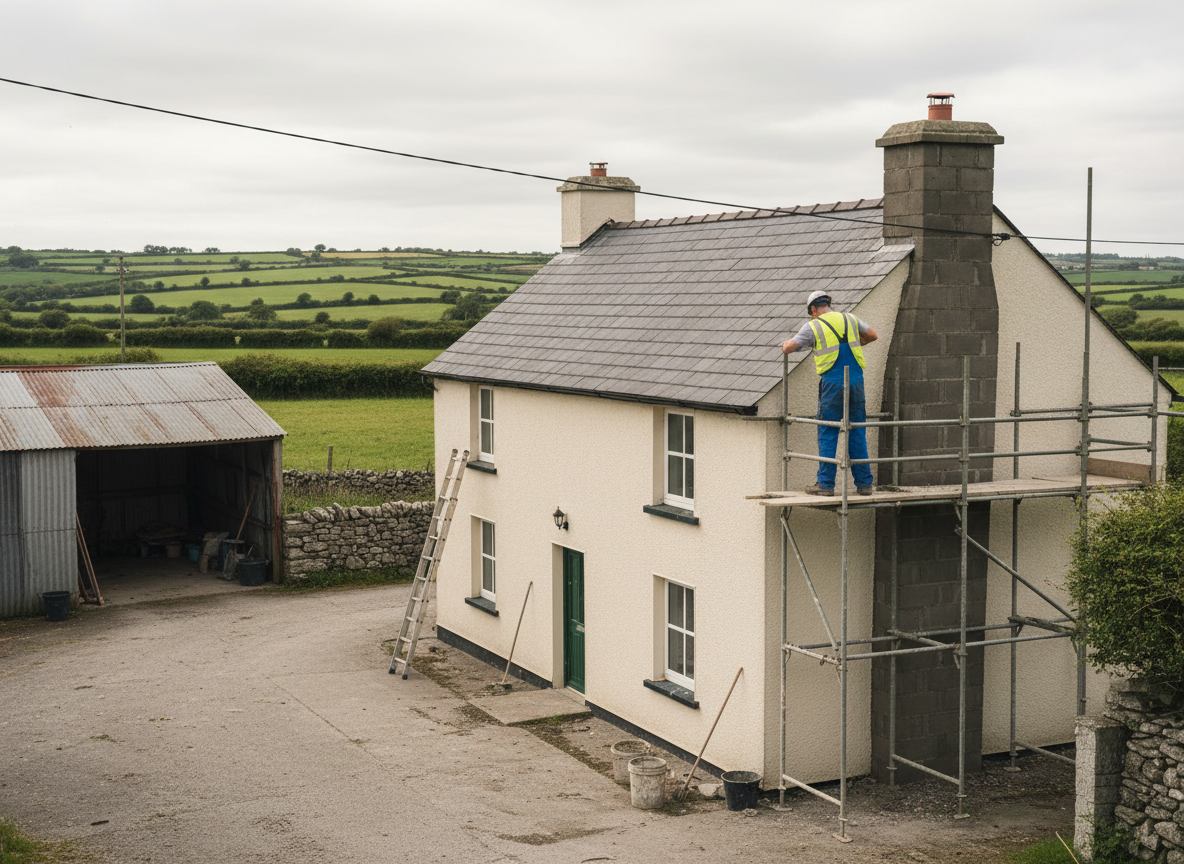
Chimney repairs in the west of Ireland often centre on damage from persistent wind-driven rain and the freeze-thaw cycles that affect older stone and brick stacks. Properties built before the 1970s commonly show open joints in the stack, cracked crowns and displaced pots after winter storms. Addressing these issues early prevents water tracking down the flue into living spaces or roof voids.
Typical repair work includes raking out and repointing the stack with lime-based mortar suited to traditional construction, replacing damaged pots or adding chimney caps, and renewing lead or cement fillets where the stack meets the roof. In agricultural buildings the same principles apply, though access and scale differ from domestic work.
Scope depends on height, access, whether the chimney remains in use, and the condition of surrounding roof timbers or slates. Coastal properties in Sligo and Mayo often require more frequent attention to salt-laden rain that accelerates mortar breakdown.
Common Reasons for Chimney Repairs
Wind-driven rain penetrating open joints, cracked flue liners allowing smoke and heat escape, moss and algae growth trapping moisture, and storm displacement of pots or cowls.
What the Work May Include
Removal of vegetation, repointing of the full stack or selected faces, installation of new flue liners where the original has failed, and making good to roof flashings disturbed during the repair.
Technician insight
In Galway the thing that catches most people out with Chimney Repairs is how quickly the prevailing south-westerly rain finds any open joint on the west face of a stack; older rendered houses on the coast often look sound from the road but the mortar behind the render has already washed out.
Example Situation
For example, a property may show damp patches on an upstairs ceiling directly below a chimney after successive winter storms. Inspection reveals open joints on the prevailing wind side of the stack and a cracked crown allowing water to track down the flue. Work would focus on repointing the affected elevations, rebuilding the crown and renewing the lead flashings at roof level to restore weather protection.
Chimney Repairs Services We Offer
✓Chimney Stack Repointing
Raking out failed mortar joints and repointing with appropriate lime mortar to restore weather resistance.
✓Chimney Pot and Cowl Replacement
Removal of damaged or missing pots and fitting of new pots or ventilated cowls suited to local wind exposure.
✓Flue Lining Installation
Insertion of stainless-steel or clay liners where the existing flue has cracked or become oversized for modern appliances.
✓Chimney Crown Repair
Rebuilding or waterproofing the concrete or stone crown that caps the stack to stop water entry.
✓Lead Flashing Renewal
Replacement or dressing of lead soakers and flashings around the chimney base where they have split or pulled away.
✓Chimney Breast Masonry Repair
Repair of internal or external brick or stonework on the breast where movement or water damage has occurred.
How it works
- 1
Site Assessment
Visual inspection from ground and roof level to record stack condition, access requirements and any linked roof defects.
- 2
Scope and Access Planning
Agreement on which faces or elements require work and the method of access, taking account of roof pitch and neighbouring structures.
- 3
Repair Execution
Carrying out the agreed masonry, flashing or lining work while protecting roof coverings and rainwater goods.
- 4
Final Check and Clearance
Inspection of completed work, removal of debris and confirmation that the flue remains clear and weather-tight.
Pricing
Cost is influenced by stack height, number of elevations requiring work, roof access difficulty, and whether lining or structural repairs are needed.